Showing 17–27 of 27 results

Mitutoyo Dial Indicators – Plunger Dial
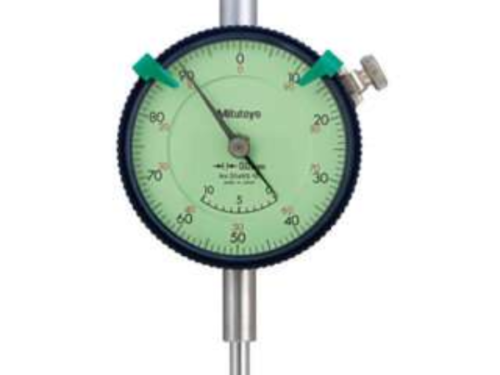
What is a plunger dial gauge? A plunger dial gauge is a dial indicator whose spindle moves straight in and out along its own axis. Movement is magnified through a rack, pinion and gear train onto a pointer, or read by an encoder on digital models. It checks runout, flatness, height differences and alignment.
A dial indicator is a comparative measuring instrument that shows small linear displacement on a graduated dial or digital display. A plunger type uses a spring-loaded spindle, while a lever type uses a contact arm. Both detect runout, flatness, parallelism and dimensional variation against a reference.
What is a dial indicator?
Dial indicators measure variation rather than absolute size. They compare a feature against a set zero or a reference standard.
A plunger dial gauge measures linear movement along the axis of its spindle.
Plunger vs lever dial indicators
A plunger dial gauge uses a spring-loaded spindle that moves in line with the contact. A lever dial gauge uses a pivoting arm for tight or angled access. Choose a plunger type for straight-line measurement and a lever type where access is restricted.
| Feature | Plunger dial indicator | Lever dial test indicator |
|---|---|---|
| Contact motion | Straight, along the spindle axis | Pivoting stylus arc |
| Measuring range | Longer travel | Short travel |
| Best fit | Height, runout, flatness, comparator work | Bores, slots, tight spaces, machine centring |
| Common error source | Spindle not perpendicular to surface | Cosine error from stylus angle |
Plunger dial indicators offer longer measuring travel than lever dial test indicators.
Analog vs digital dial gauges
Analog dial gauges read from a graduated dial. Digital indicators show readings on a display and can output data for records and SPC workflows. Both types are available in the Mitutoyo range.
How to choose a dial indicator
Match the gauge type to access requirements: plunger for straight-line work, lever for restricted or angled positions. Consider the measuring range, graduation and whether data output is needed. Confirm exact models, ranges and graduations from the live product listing below.
- Match the measuring range to the expected travel.
- Pick the graduation on the product listing against your tolerance.
- Choose dial size and mounting style for your fixture or stand.
- Choose digital if you need data output or tolerance judgement.
- Choose waterproof types near coolant.
- Add a magnetic or comparator stand and suitable contact points.
A plunger dial gauge should be mounted perpendicular to the surface to limit measurement error.
Mounting with stands and bases
Mount indicators on comparator stands, magnetic bases or fixtures for stable measurement. A rigid mount reduces measurement scatter and ensures consistent contact force. See the Mitutoyo comparator stand range for compatible options.
A rigid stand reduces deflection errors when using a plunger dial gauge.
Frequently asked questions
What is a dial indicator used for?
It measures small linear variation such as runout, flatness and dimensional deviation against a reference.
What is the difference between a plunger and lever dial gauge?
A plunger gauge moves in a straight line. A lever gauge uses a pivoting arm for restricted access.
What is a digital dial gauge?
A digital dial gauge shows readings on an electronic display and can output measurement data.
Do I need a stand to use a dial indicator?
Usually yes. A comparator stand or magnetic base holds the indicator steady during measurement.
How is a dial indicator calibrated?
It is checked against a traceable standard or gauge block setup. Contact BTSA for calibration support.
What is a back plunger dial indicator?
It is a plunger indicator with the spindle at the back of the body. It suits fixtures where side mounting is not possible.
How do I mount a plunger dial gauge?
Clamp the stem in a magnetic stand, comparator stand or fixture. Keep the spindle perpendicular to the surface being measured.
How often should dial indicators be calibrated?
It depends on usage and your quality system. Many plants calibrate yearly and check before critical setups.