A torque wrench applies and limits torque to larger fasteners such as structural bolts and nuts, typically across a mid-to-high torque range. A torque screwdriver is built for smaller fasteners such as screws in electronics and precision-instrument assembly, covering a much lower torque range with a screwdriver-style handle instead of a wrench body.
How a Torque Wrench Works
Related: JAFUJI torque tools
A torque wrench applies a controlled, measured amount of rotational force to a fastener, either indicating the torque as it is applied or signalling once a pre-set value has been reached. Most designs use an internal mechanism, a calibrated spring in click-type models, a deflecting beam in beam-type models, or an electronic strain sensor in digital models, to translate applied force into a torque reading.
It is used on larger fasteners such as structural bolts, machine mounting nuts, and flange fasteners, wherever under-tightening risks a loose joint and over-tightening risks a stripped thread or a damaged component.
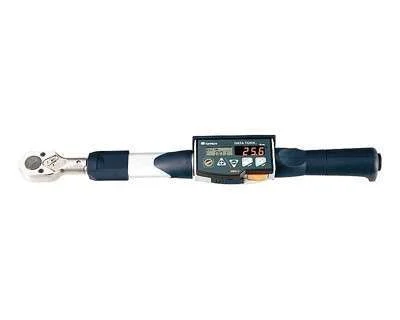
How a Torque Screwdriver Works
Related: JAFUJI torque screwdriver series
A torque screwdriver applies that same underlying principle, a calibrated mechanism that limits or indicates torque, but in a screwdriver-style handle sized for far smaller fasteners. Common configurations include adjustable click-type screwdrivers, similar in operating principle to a click-type wrench but scaled down, and preset or dial-indicating models built for a narrower, lower torque band.
It is used on small screws in electronics assembly, precision-instrument builds, and any application where a standard torque wrench would be too large, too coarse, or simply incapable of the fine control a small fastener requires.
Torque Range and Application Fit
The most fundamental difference between the two tool types is the torque range each is built to cover. A torque wrench typically operates from a moderate torque level up through much higher values suited to structural and mechanical fastening.
A torque screwdriver operates at the opposite end of the scale, built for the low torque values typical of small machine screws, terminal screws, and instrument-panel fasteners, where the applied force needs far finer control than a wrench mechanism can practically deliver.
Choosing between them starts with the fastener itself. A large structural or mounting bolt calls for a torque wrench regardless of how carefully a torque screwdriver is adjusted, since the tool is simply not built for that load. A small electronics or panel screw calls for a torque screwdriver for the opposite reason: the fine control needed at that scale.
Reading and Setting Each Tool
Adjustable click-type torque wrenches are set to a target value on a graduated scale and produce an audible and tactile click once that value is reached, after which the operator stops applying force. Beam-type wrenches give a direct, continuous reading on a scale as force is applied, requiring the operator to watch the pointer and stop at the target value manually. Digital torque wrenches display the applied torque numerically and can typically log or flag when a target value is reached.
Torque screwdrivers generally follow the same click-type or dial-indicating principle as their larger counterparts, scaled down for their lower torque range. Adjustable click-type screwdrivers are set to a target value in the same way as a click-type wrench, while preset models are fixed to a single value from the point of purchase or a prior adjustment.
Bidirectional and Interchangeable Configurations
Related: dual-way torque wrench
Many torque wrenches are available in dual-direction, or bidirectional, configurations, allowing controlled torque to be applied when loosening a fastener as well as when tightening it, which is useful in maintenance settings where a fastener needs to be removed under controlled, documented force rather than simply broken loose.
Interchangeable-head torque wrenches extend a single calibrated body across multiple socket or drive sizes, letting one tool cover a wider range of fastener types without needing a separate wrench for each. This configuration suits facilities working across a varied mix of fastener sizes within the same general torque range, since the calibrated mechanism itself does not need to be duplicated.
Accuracy, Calibration, and Maintenance Differences
Both tool types depend on their internal mechanism holding its calibrated accuracy over time, and both should be checked periodically against a certified reference rather than assumed accurate indefinitely, particularly after heavy use or if the tool has been dropped.
Click-type mechanisms, in wrenches and screwdrivers alike, are generally recommended to be stored at their lowest setting when not in use, since leaving a spring-loaded mechanism compressed at a high setting for extended periods can affect its long-term accuracy. Digital models add electronics and a battery to the maintenance picture, alongside the mechanical calibration check.
Because a torque screwdriver’s working range is narrower and its mechanism smaller, drift within that mechanism can represent a larger proportional error than the same absolute drift would on a torque wrench’s wider range. This makes regular calibration checks proportionally more important on lower-range instruments.
Cost Considerations
A standard adjustable click-type torque wrench sits at a moderate price point within a given accuracy class, reflecting its established, widely produced mechanical design. Dual-way and interchangeable-head configurations typically cost more than a fixed single-direction, single-drive wrench, due to the added mechanical complexity.
Torque screwdrivers are generally lower cost than torque wrenches in absolute terms, reflecting their smaller size and lower-range mechanism, though precision preset or dial-indicating models can sit at a comparable price to an entry-level torque wrench depending on the required accuracy class.
Comparison Table
The table below summarises the practical differences between the two tool types.
| Factor | Torque Wrench | Torque Screwdriver |
|---|---|---|
| Typical torque range | Moderate to high, suited to structural and mechanical fasteners | Low, suited to small screws in electronics and instrument assembly |
| Typical fastener size | Bolts, nuts, and flange fasteners | Small machine screws and terminal screws |
| Common configurations | Adjustable click-type, dual-way, interchangeable-head, digital | Adjustable click-type, preset, dial-indicating |
| Reading method | Click, beam scale, or digital display | Click or dial indication, scaled for lower torque |
| Best fit | Structural and mechanical fastening tasks | Precision, low-torque fastening tasks |
Pros and Cons
Torque Wrench
Pros:
- Covers the moderate-to-high torque range needed for structural and mechanical fasteners
- Dual-way and interchangeable-head configurations extend versatility across fastener types
- Familiar to most maintenance and assembly technicians
Cons:
- Not suited to the fine control small electronics or instrument screws require
- Larger body and handle length can limit access in confined spaces
Torque Screwdriver
Pros:
- Delivers the fine, low-range control small fasteners need that a wrench cannot provide
- Compact handle suits confined assembly work such as electronics and instrument panels
- Preset models remove the risk of an accidental setting change on a repetitive task
Cons:
- Limited to a narrow, low torque range unsuited to structural fastening
- Proportional calibration drift matters more on a narrower working range
How to Choose Between Them
The most reliable way to choose is to identify the fastener first, not the tool. If the fastener is a structural or mechanical bolt or nut, a torque wrench is the answer regardless of how finely a torque screwdriver might be adjusted. If the fastener is a small screw in an electronics or instrument assembly, a torque screwdriver is required instead.
Once the tool category is confirmed, the next decision is which configuration fits the work. A facility handling a single fastener size in one rotational direction may only need a standard fixed-drive wrench or screwdriver, while a facility servicing a wider mix of fastener sizes, or needing controlled removal as well as tightening, benefits from a dual-way or interchangeable-head configuration.
Common Applications
Torque wrenches are widely used in automotive and machinery assembly, structural bolting on equipment and fixtures, and maintenance tasks where a fastener must be tightened to a documented specification, such as flange bolts on pressure-bearing equipment.
Torque screwdrivers are common in electronics assembly, precision-instrument manufacturing, and any panel or enclosure work where a small screw must be seated firmly without over-tightening and damaging a delicate housing or stripping a fine thread.
Ergonomics and Access Considerations
Handle length and body size affect more than comfort. A torque wrench’s longer handle provides the leverage its higher torque range requires, but that same length can make it awkward to use in a confined space, such as a tightly packed equipment enclosure or a recessed mounting point.
A torque screwdriver’s compact, pen-like or T-handle body is built for exactly those confined-access situations, allowing an operator to work close to a small fastener with better visibility and control than a full-size wrench would allow, even setting torque range aside.
T-handle configurations, in particular, suit repetitive bench assembly work, where an operator applies the same low-torque fastening action many times across a shift, since the handle shape supports a consistent, controlled grip over extended use.
Torque Tools in Regulated or Documented Assembly Environments
In industries where fastener torque is a documented quality requirement, such as aerospace, defence, and certain automotive and medical-device assembly lines, the choice between a torque wrench and a torque screwdriver is rarely optional. The applicable specification typically names the required torque value and tolerance for a given fastener, and the tool selected must be capable of holding that accuracy across its working range.
In these environments, digital torque wrenches and dial-indicating torque screwdrivers are often preferred over simple click-type tools specifically because they support a recorded, traceable value for each fastening event, rather than only a pass or fail signal at the point of use.
Less formally regulated maintenance and general assembly work can rely more heavily on well-maintained click-type tools, provided they are kept within a routine calibration schedule and operators are trained not to override the click signal.
Common Mistakes When Using Torque Tools
Using a general-purpose wrench or screwdriver instead of a calibrated torque tool for a specified fastener is the most basic error, since it removes any control over the applied force entirely.
Continuing to apply force past a click-type tool’s signal, sometimes called overriding the click, is a frequent cause of over-torqued fasteners, since the click is a signal to stop, not a suggestion. Setting a torque wrench or screwdriver to the wrong value, often by misreading a scale under poor lighting, is another common source of incorrectly torqued fasteners.
Leaving an adjustable click-type mechanism set at a high value during storage, rather than returning it to its lowest setting, can gradually affect the tool’s long-term calibration accuracy.
Maintenance and Calibration Best Practices
Both torque wrenches and torque screwdrivers should be checked against a certified reference at a defined interval, and immediately after any drop or suspected impact, rather than relying solely on a fixed calendar schedule.
Storing click-type tools at their lowest setting, keeping the mechanism clean and dry, and avoiding using a torque tool as a general-purpose wrench or screwdriver for non-torque-controlled work all help preserve accuracy between formal calibration checks.
The clearest way to choose between a torque wrench and a torque screwdriver is by fastener size and required torque range, not by brand or price. Structural and mechanical bolts call for a torque wrench; small electronics and instrument screws call for a torque screwdriver, and the two tool types are not interchangeable substitutes for each other.
FAQs
What is the main difference between a torque wrench and a torque screwdriver?
A torque wrench covers a moderate-to-high torque range for structural and mechanical fasteners. A torque screwdriver covers a much lower torque range, built for small screws in electronics and instrument assembly.
Can a torque screwdriver be used in place of a torque wrench?
No. A torque screwdriver’s mechanism is built for a low torque range and is not designed to safely or accurately apply the higher torque values a structural or mechanical bolt typically requires.
What does dual-way mean on a torque wrench?
A dual-way, or bidirectional, torque wrench applies controlled, measured torque when loosening a fastener as well as when tightening it, which suits maintenance work requiring documented force in both directions.
Why would I choose an interchangeable-head torque wrench?
An interchangeable-head design lets one calibrated wrench body cover multiple socket or drive sizes, useful for facilities working across a varied mix of fastener types within the same general torque range.
How often should a torque wrench or torque screwdriver be calibrated?
Both should be checked against a certified reference at a defined interval, and immediately after any drop or suspected impact, rather than relying only on a fixed calendar schedule.
What happens if I keep applying force after a click-type tool clicks?
Continuing past the click, sometimes called overriding the click, is a common cause of over-torqued fasteners. The click is a signal that the set torque value has been reached and force should stop.
Should a click-type torque wrench be stored at a high or low setting?
It should generally be returned to its lowest setting for storage. Leaving the internal spring mechanism compressed at a high setting for extended periods can affect long-term calibration accuracy.
Why is calibration drift more of a concern on a torque screwdriver than a torque wrench?
Because a torque screwdriver’s working range is narrower, the same absolute amount of mechanical drift represents a larger proportional error than it would on a torque wrench’s wider range.
Can a digital torque wrench replace a click-type wrench for documented work?
A digital torque wrench can display and often log the applied torque numerically, which suits work requiring a documented reading, while a click-type wrench relies on the operator’s response to an audible signal.
What type of fastener typically needs a torque screwdriver rather than a torque wrench?
Small machine screws and terminal screws in electronics assembly, precision-instrument builds, or panel and enclosure work typically need a torque screwdriver’s finer, lower-range control.
Is a preset torque screwdriver better than an adjustable one?
A preset model removes the risk of an accidental setting change on a repetitive single-value task, while an adjustable model offers flexibility across multiple torque values for varied work.
Do torque wrenches and torque screwdrivers use the same underlying mechanism?
They share the same underlying principle, a calibrated mechanism that limits or indicates applied torque, but scaled to very different ranges, click-type, beam-type, and digital variants exist for both.
Why does a beam-type torque wrench require a different technique than a click-type one?
A beam-type wrench gives a continuous reading on a scale as force is applied, requiring the operator to watch the pointer and stop manually at the target value, unlike a click-type tool’s automatic signal.
Can the wrong torque setting damage a fastener or component?
Yes. Under-tightening risks a loose joint, while over-tightening risks a stripped thread or a damaged component, which is why selecting and correctly setting the right torque tool matters for both outcomes.
Request a Quote — Contact BTSA for product selection guidance and calibration support.