Radii appear on almost every machined part. Fillets reduce stress at shoulders, and corner radii remove sharp edges for safety and fit. A wrong radius can weaken a part or stop it from seating. The radius gauge is the quickest way to check them on the shop floor.
What is a radius gauge?
A radius gauge, also called a fillet gauge, is a set of thin steel leaves cut to precise radii. Each leaf has a convex profile for checking internal radii and a concave profile for checking external radii. The operator matches a leaf to the part and checks for light between them.
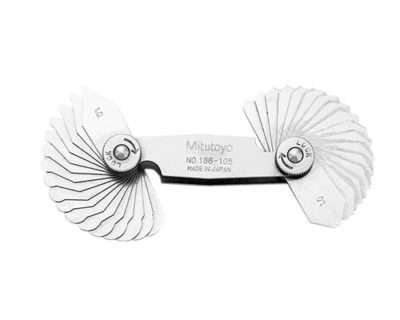
Radius gauges are comparison tools. They do not give a numerical reading. They confirm whether a radius matches a nominal size, or which leaf it sits closest to.
What are internal and external radii?
| Radius type | Also called | Where it appears | Leaf profile used |
|---|---|---|---|
| Internal radius | Fillet, concave radius | Inside corners, shaft shoulders, slot bottoms | Convex leaf end |
| External radius | Corner radius, convex radius | Outside edges, rounded corners, part ends | Concave leaf end |
How do you use a radius gauge?
To use a radius gauge, pick the leaf that matches the nominal radius on the drawing. Hold it square to the radius, in full contact with both adjoining faces. View the joint against a light source. No light between leaf and part means the radius matches; visible light shows where it differs.
- Read the drawing. Note the nominal radius and whether it is internal or external.
- Clean the part and the leaf. Burrs and chips give false light gaps.
- Select the leaf. Use the convex end for internal radii and the concave end for external radii.
- Hold the leaf square. Keep it perpendicular to the radius and in line with the part axis.
- Seat it against both faces. The leaf must touch the faces on either side of the radius.
- Check against light. Hold the part between your eye and a light source or light box.
- Read the light gap. Use the table below to judge whether the part radius is larger or smaller.
- Try the next leaf if needed. Step up or down until you find the best match.
How do you read the light gap?
| Check | Light seen | What it means |
|---|---|---|
| External radius, concave leaf | No light | Radius matches the leaf |
| External radius, concave leaf | Light at the centre | Part radius is larger than the leaf |
| External radius, concave leaf | Light at the edges | Part radius is smaller than the leaf |
| Internal radius, convex leaf | No light | Radius matches the leaf |
| Internal radius, convex leaf | Light at the centre | Part radius is smaller than the leaf |
| Internal radius, convex leaf | Light at the edges | Part radius is larger than the leaf |
A quick way to remember: light shows where the part and leaf do not touch.
What mistakes should you avoid?
- Tilting the leaf. A tilted leaf reads a larger radius than the true value.
- Checking on a burr. Deburr the edge first, or the leaf rocks on the burr.
- Using the wrong end. Convex for fillets, concave for corners.
- Poor lighting. Use a light box or bright background for small gaps.
- Bent leaves. A bent leaf gives false gaps; replace it.
When is a radius gauge not enough?
Radius gauges suit pass or fail checks against a nominal size. They do not give a measured value or check tangency closely. For tight radius tolerances, use an optical comparator, a contour measuring system or a coordinate measuring machine. For irregular profiles that are not true radii, a profile gauge copies the shape for comparison.
Radius gauge vs thread pitch gauge: how are they related?
Both are leaf-type comparison gauges read by fit and light. A radius gauge checks curved profiles. A thread pitch gauge checks the pitch of a thread by matching its teeth. Many inspection kits carry both side by side.
How do you care for a radius gauge?
- Wipe leaves clean and apply a light rust preventive after use.
- Fold leaves back into the holder; do not leave them fanned out.
- Never use a leaf as a scraper or shim.
- Replace bent or nicked leaves rather than straightening them.
- Include radius gauges in your calibration schedule.
BTSA supports calibration through NABL accredited calibration services at SV Precision Instruments. The same light gap method is used with leaf gauges in our guide on how to use a feeler gauge. To check a certificate before filing it, read how to read a calibration certificate.
Where can you buy radius gauges in India?
BTSA has supplied precision measuring instruments since 1942. Browse Mitutoyo radius gauges, thread pitch gauges and profile gauges, or explore all Mitutoyo measuring instruments.
Request a quote for radius gauge sets
Frequently asked questions
What is a radius gauge used for?
It checks internal fillets and external corner radii against a nominal size.
Which end of a radius gauge checks a fillet?
The convex end checks internal radii such as fillets. The concave end checks external corners.
How do you know if a radius is correct?
Hold the matching leaf square to the part against light. No light gap means the radius matches.
What does light at the centre of a radius gauge mean?
On an external radius, the part is larger than the leaf. On an internal radius, it is smaller.
Is a radius gauge the same as a fillet gauge?
Yes. Both names describe the same leaf-type gauge for checking radii.
When should you use a profile projector instead of a radius gauge?
Use optical or contour measurement when you need a measured value or a tight radius tolerance.