Calibrating a micrometer means comparing its readings against traceable reference standards, usually grade-1 or grade-0 gauge blocks. The instrument is checked for zero error, linearity across its measuring range, flatness of anvils, and parallelism of measuring faces. NABL-accredited calibration delivers a traceable certificate accepted by quality systems across India.
Why calibrate a micrometer?

A micrometer that is not calibrated cannot be trusted to deliver accurate measurements. Even a well-built instrument drifts over time due to wear, mishandling, and temperature exposure.
Calibration restores measurement confidence by comparing the instrument against reference standards traceable to national bodies. In India, this means traceability through NPL via NABL-accredited laboratories.
Regulated industries such as aerospace, automotive, pharma, and medical devices mandate calibration as part of their quality systems. Missing or expired calibration is a common audit non-conformance in ISO 9001 and IATF 16949 reviews.
What you need before calibration
Calibration must be performed in a controlled environment with the right reference standards. Skipping any step below introduces uncertainty that defeats the purpose of calibration.
Equipment and conditions:
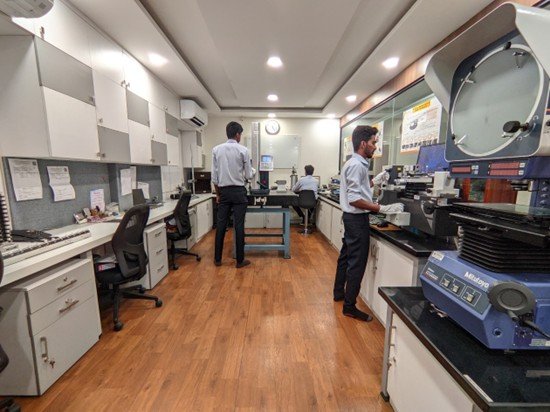
- A set of traceable gauge blocks, typically grade 0 or grade 1
- A calibrated optical flat for measuring-face flatness
- An optical parallel set for measuring-face parallelism
- A calibration stand or fixture for stability
- A temperature-controlled environment, commonly 20 °C ± 1 °C
- Lint-free wipes and approved cleaning solvent
- A copy of the original manufacturer specification for the micrometer
The reference standards themselves must hold a current calibration certificate. Using uncalibrated gauge blocks invalidates the entire procedure.
Step-by-step calibration procedure
Follow these steps in sequence. Each step builds on the previous one, and skipping any check leaves a gap in the calibration record.
Step 1: Pre-calibration inspection
Inspect the micrometer for visible damage, corrosion, or excessive wear on the anvils. Check that the thimble rotates smoothly without binding or play.
Clean the anvils with a lint-free wipe and an approved solvent. Allow the instrument to acclimatise to room temperature for at least one hour before measurement.
Step 2: Check the zero reading
Close the anvils gently using the ratchet or friction thimble. Confirm that the reading is exactly zero on both the sleeve and thimble scales.
If a zero error is found, record it before any further test. Some micrometers have an adjustable sleeve that allows zero correction using a setting key.
Step 3: Check measuring-face flatness
Place a calibrated optical flat between the anvils. Observe the interference fringes under monochromatic light to assess flatness.
A flat measuring face typically shows fewer than two bands of distortion. Excessive distortion indicates anvil wear and may require relapping or instrument replacement.
Step 4: Check parallelism of measuring faces
Use a set of optical parallels at four different rotational positions in the measuring range. Each rotational position is approximately 90° apart.
Count the interference fringes at each position. Variation across positions reveals parallelism error, which directly affects measurement accuracy.
Step 5: Verify linearity across the measuring range
Select gauge blocks that span the micrometer’s full range. For a 0–25 mm outside micrometer, common check points are 2.5, 5.1, 7.7, 10.3, 12.9, 15.0, 17.6, 20.2, 22.8, and 25.0 mm.
Close the anvils on each gauge block using consistent thimble pressure. Record the micrometer reading and compare against the nominal value of the gauge block.
The deviation at each check point should be within the manufacturer’s stated tolerance. Many quality systems also apply a measurement uncertainty budget when interpreting results.
Step 6: Calculate measurement uncertainty
Measurement uncertainty accounts for all known sources of variation in the calibration. Common contributors include gauge block uncertainty, temperature variation, repeatability, and operator effects.
A complete uncertainty budget is required for NABL-accredited certificates. Most internal calibration teams use published guidance such as JCGM 100 to construct their budget.
Step 7: Issue the calibration certificate
Document all readings, deviations, environmental conditions, and the uncertainty budget. The final calibration certificate should state pass or fail against the applicable tolerance.
A NABL-accredited certificate carries the NABL logo, scope reference, and a unique certificate number. It is the only calibration record accepted in many regulated supply chains in India.
How often should a micrometer be calibrated?
Calibration frequency depends on usage, environment, and the quality system in force. There is no single rule that fits every workshop.
| Use case | Typical calibration interval |
|---|---|
| Daily-use shop floor micrometer | 6 months |
| QA lab micrometer (controlled use) | 12 months |
| Reference master micrometer | 12–24 months |
| After a drop, impact, or visible damage | Immediately |
| After repair or anvil relapping | Immediately |
Internal procedures often shorten the interval if drift is detected during interim checks. Annual calibration is a common baseline for most general-purpose micrometers in India.
Common calibration errors to avoid
Even careful technicians make mistakes during micrometer calibration. The errors below are the ones most often raised during NABL audits and customer reviews.
- Skipping temperature acclimatisation. Cold or warm instruments give false readings until they equilibrate.
- Inconsistent thimble pressure. Use the ratchet stop or friction thimble for repeatable closing force.
- Using uncalibrated gauge blocks. This defeats the entire purpose of the calibration.
- Ignoring flatness and parallelism checks. Linearity alone is not enough to validate the instrument.
- Missing uncertainty budget. A certificate without uncertainty is not NABL-compliant.
Should you calibrate in-house or use a NABL lab?
Many manufacturing teams ask whether in-house calibration is sufficient. The answer depends on the quality system, customer requirements, and the qualifications of the in-house team.
In-house calibration may be acceptable for internal monitoring, provided traceable reference standards are used. NABL-accredited external calibration is typically required for customer-facing measurements and regulated industries.
BTSA’s NABL-accredited calibration laboratories handle micrometer calibration across Mumbai, Chennai, Bangalore, Hyderabad, and Coimbatore. Our service includes pickup, calibration, certificate issue, and on-time return to your QA team.
Frequently asked questions
What is the difference between calibration and verification?
Calibration establishes the relationship between a micrometer’s readings and a reference standard, typically with an uncertainty statement. Verification only checks that the instrument is within a defined tolerance at given points. Calibration is the broader, traceable activity.
Can I calibrate a micrometer using only a single gauge block?
A single gauge block cannot verify linearity across the measuring range. A proper calibration uses multiple gauge blocks spanning the full range, plus optical flats and parallels. Single-block checks are interim functional checks, not calibration.
Why is temperature so important during calibration?
Steel components expand and contract with temperature, and even one degree of variation can introduce micron-level error. Calibration is typically performed at 20 °C in line with international metrology practice. Most NABL-accredited laboratories maintain tight temperature control during testing.
What does a NABL calibration certificate prove?
A NABL certificate proves that the calibration was performed under an accredited scope, using traceable references, by qualified personnel. It states the deviation, uncertainty, and pass or fail status. The certificate is accepted by customers, auditors, and regulators in India.
How long does a typical micrometer calibration take?
A standard 0–25 mm outside micrometer calibration usually takes 30 to 60 minutes including documentation. Turnaround time at a calibration laboratory depends on lot size, service-level agreement, and instrument complexity. Specialised geometries may take longer.
What should I do if my micrometer fails calibration?
A failed calibration typically points to anvil wear, screw damage, or zero drift. Options include adjustment, anvil relapping, or replacement, depending on the cause. Continue using the instrument only after a successful re-calibration.
Calibrate your micrometers with BTSA
BTSA’s NABL-accredited calibration laboratories deliver traceable certificates accepted by quality systems across Indian industry. Our metrology engineers handle micrometers, calipers, gauges, and a wide range of precision instruments under one roof.