Aerospace QA depends on traceable, high-precision measurement of every flight-critical part. Common instruments include outside and bore micrometers, height gauges, surface plates, surface roughness testers, and coordinate measuring machines. Tolerances often run in single-digit microns, and calibration cadence is typically six-monthly or tighter under AS 9100 and related quality systems.
Why aerospace is unique in metrology

Aerospace QA does not tolerate the same risk thresholds accepted in other industries. The cost of a single dimensional failure can range from rework expense to safety consequence.
Indian aerospace and defence manufacturing has grown rapidly across HAL, ISRO, defence offset partners, and a maturing private-sector supply base. With that growth comes a deeper need for traceable, repeatable measurement.
This guide outlines the precision measurement landscape for aerospace QA. It is written for QA managers, inspection engineers, and metrology heads in Indian aerospace manufacturing.
What makes aerospace tolerances so demanding?
Aerospace components combine three pressures that drive tight tolerances. Each one pushes measurement uncertainty toward the lowest practical limit.
1. Flight safety. Rotating parts, structural elements, and engine components must perform reliably across mission cycles. Dimensional deviation outside tolerance can lead to vibration, fatigue, or catastrophic failure.
2. Weight optimisation. Aerospace structures are designed close to material limits to save weight. Out-of-tolerance dimensions remove engineering margin and shift load paths.

3. Interchangeability. Many aerospace parts must be interchangeable across batches, suppliers, and maintenance organisations. Strict dimensional control keeps maintenance and overhaul economics viable.
These pressures combine to produce tolerance envelopes that are routinely in single-digit microns for critical features. Some surface roughness specifications are tighter still.
Core precision measuring instruments used in aerospace QA
The aerospace QA toolkit overlaps with general manufacturing but uses higher-grade instruments more consistently. The list below covers the instruments most commonly seen on Indian aerospace QA floors.
Outside and inside micrometers
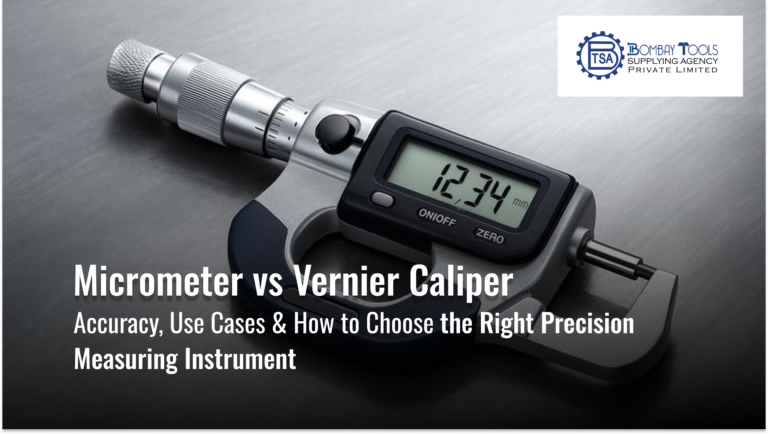
Outside micrometers cover external shaft dimensions, fastener diameters, and machined feature checks. Inside micrometers and three-point bore micrometers handle internal diameters of bores, sleeves, and bushings.
In aerospace QA, digital micrometers with 0.001 mm resolution are standard. Data output to QA software supports statistical process control and audit-ready records.
Vernier and digital calipers
Calipers handle quick checks at moderate accuracy. They are typically used for first-article verification and routine in-process checks.
Aerospace QA labs usually stock digital calipers from precision brands. Their role is complementary to micrometers, not a substitute for them.
Height gauges
Vernier, dial, and digital height gauges measure feature heights and step dimensions on machined parts. They are essential for marking out, layout verification, and feature-height inspection.
Digital height gauges with data output are common in aerospace QA. Their integration with QA software supports fast batch verification of repetitive parts.
Bore gauges and three-point internal micrometers
Bore inspection is one of the most demanding measurement tasks in aerospace QA. Engine cylinders, gearbox housings, bearing seats, and bushings all require accurate bore measurement.
Dial bore gauges, three-point internal micrometers, and air bore gauges are common. Selection depends on bore size, tolerance, and inspection volume.
Surface plates and granite reference flats
A granite surface plate provides the precision reference flat on which many other measurements are taken. Grade 0 or grade 00 plates are common in aerospace QA labs.
Surface plates are themselves calibrated periodically. Their flatness directly affects every measurement performed on them.
Surface roughness testers
Surface roughness specifications are critical in aerospace. Fatigue life, sealing performance, and bearing function all depend on controlled surface finish.
Portable and benchtop surface roughness testers, often based on a stylus profilometer, are standard in aerospace QA. Optical and non-contact systems are increasingly common for high-volume inspection.
Coordinate measuring machines (CMM)
CMMs deliver three-dimensional dimensional verification of complex aerospace parts. They are central to first-article inspection and in-process verification of complex geometry.
CMM use in aerospace QA spans bridge-type, cantilever, and portable arm systems. Each platform suits a different size class of part.
Coating thickness gauges
Aerospace coatings such as anodising, plating, and protective paint must be measured to confirm thickness. Magnetic, eddy-current, and ultrasonic coating thickness gauges all see service in aerospace QA.
Hardness testers
Heat-treated and surface-treated aerospace parts must be verified for hardness. Rockwell, Brinell, and Vickers hardness testers are widely used.
Typical tolerance bands seen in Indian aerospace QA
Tolerances vary by part class, function, and the originating design authority. The table below gives a directional view of what aerospace QA teams typically encounter.
| Feature class | Typical tolerance band |
|---|---|
| Engine rotating diameters | Single-digit microns to low double-digit microns |
| Structural machined features | Tens of microns |
| Hole diameters for precision fasteners | Tight micron-level tolerances |
| Bearing seats and journals | Single-digit microns |
| Surface roughness on rotating contact surfaces | Sub-micron Ra values |
| Coating thickness on protective layers | Micron-level tolerance windows |
The exact tolerance is always defined by the design drawing and the applicable specification. Use the table only as orientation for instrument selection planning.
Quality systems and the calibration cadence
Aerospace QA in India typically operates under one or more of the following standards:
- AS 9100 for design and manufacture of aerospace products
- AS 9120 for distributors of aerospace parts
- AS 9110 for maintenance, repair, and overhaul organisations
- NADCAP accreditations for special processes
- Customer-specific approvals from major OEMs
These standards govern not just the measurement methods but also the calibration cadence, calibration records, and supplier qualification.
A typical aerospace calibration cadence is more conservative than general manufacturing. Common patterns seen in Indian aerospace QA include:
- Six-monthly calibration for high-use shop-floor instruments
- Annual calibration for QA-lab reference instruments
- Event-based re-calibration after any drop, impact, or visible damage
- Pre-use checks against masters at the start of every shift
NABL-accredited calibration is the baseline expectation. Many aerospace customers also expect calibration certificates with full uncertainty budgets and traceability statements.
Environmental control in aerospace metrology
Aerospace measurement is highly sensitive to temperature, humidity, and vibration. The smaller the tolerance, the more demanding the environmental control.
Typical environmental conditions in an aerospace QA lab include:
- Temperature stabilised at 20 °C, often with tight tolerance
- Humidity controlled, typically below 60 percent
- Low vibration, often isolated from the production floor
- Clean conditions to prevent particulate contamination of high-grade surfaces
Parts and instruments must equalise to lab temperature before measurement. The equalisation time scales with part mass and starting temperature difference.
Common QA failure modes and how to avoid them
The audit findings below appear frequently in Indian aerospace QA reviews. Each one is preventable with disciplined practice.
- Expired calibration certificates on shop-floor instruments. Track calibration due dates with automated reminders in the QA system.
- Missing measurement uncertainty in records. Ensure all certificates and in-house records carry uncertainty values.
- Inappropriate instrument selection for the tolerance. Maintain a documented instrument-to-tolerance selection guide.
- Operator technique variation. Implement structured operator training and periodic competency assessment.
- Setting master not on its own calibration cycle. Treat masters and gauges with equal calibration discipline.
Sourcing and calibration support for aerospace QA
BTSA, established in 1942, supplies precision measuring instruments to Indian aerospace and manufacturing customers. Our portfolio includes Mitutoyo, JAFUJI, and other established metrology brands across the instrument families above.
Our NABL-accredited calibration laboratories support aerospace QA teams in Mumbai, Chennai, Bangalore, Hyderabad, and Coimbatore. We provide pickup, calibration, certificate issue, and on-time return for production-critical instruments.
For aerospace QA managers planning their next instrument purchase or calibration cycle, our metrology engineers offer pre-purchase application support. This includes instrument selection, tolerance fit assessment, and lifecycle calibration planning.
Frequently asked questions
Which standard governs measurement traceability in Indian aerospace QA?
Aerospace QA in India relies on ISO/IEC 17025 through NABL-accredited calibration for measurement traceability. Specific quality systems such as AS 9100 then govern how calibration is recorded, used, and reviewed. Customer-specific approvals may add further requirements.
What is the typical calibration cadence for aerospace instruments?
A common pattern is six-monthly calibration for shop-floor instruments and annual calibration for lab references. Many aerospace customers shorten the cadence further for instruments used on flight-critical parts. Event-based re-calibration applies after any drop or damage.
Are CMMs essential for aerospace QA?
CMMs are essential for complex three-dimensional verification, especially during first-article inspection. They are not always required for simple feature verification, where micrometers, height gauges, and bore gauges may suffice. Most aerospace QA labs operate a mix of CMM and conventional metrology.
How does temperature affect aerospace measurements?
Steel and aluminium parts expand and contract with temperature, and even one degree can introduce micron-level error. Aerospace QA labs stabilise at 20 °C and require temperature equalisation before measurement. Tight tolerances require tighter environmental control.
What is the role of surface roughness measurement in aerospace QA?
Surface roughness affects fatigue life, sealing, bearing performance, and aerodynamic surface behaviour. Aerospace QA routinely measures Ra and related parameters on flight-critical surfaces. Both stylus and optical roughness testers are used depending on the surface and the specification.
Can a general-purpose calibration laboratory serve aerospace customers?
A NABL-accredited laboratory with appropriate scope can serve aerospace customers, subject to the customer’s qualification requirements. Some aerospace OEMs require additional approvals or audits before accepting a calibration source. Always confirm scope alignment before commissioning calibration work.