Thickness is one of the most common checks in manufacturing and maintenance. A sheet coming off a line, a pipe wall in a plant and a gasket in a store all need it. Two very different instruments handle most of this work: the ultrasonic thickness gauge and the dial thickness gauge. This guide compares them so you choose the right one first time.
What is the difference between an ultrasonic and a dial thickness gauge?
An ultrasonic thickness gauge measures thickness from one side using sound pulses, so it suits pipes, tanks and closed structures. A dial thickness gauge measures thickness between two anvils, so it needs access to both sides. It suits sheet, film, paper, rubber and small parts. Neither measures paint or plating; that needs a coating thickness gauge.
How does an ultrasonic thickness gauge work?
An ultrasonic thickness gauge sends a high-frequency sound pulse into the material through a probe. The pulse reflects from the far wall and returns to the probe. The gauge measures the travel time and multiplies it by the material’s sound velocity. Half of that distance is the thickness.
A thin layer of couplant gel removes air between probe and surface so the sound can enter. The gauge must be set to the sound velocity of the material, because sound travels at different speeds in steel, aluminium and plastic. Calibration on a reference block of the same material gives the best results. Ultrasonic gauges are also used on towers and structures in wind and solar plant maintenance.
How does a dial thickness gauge work?
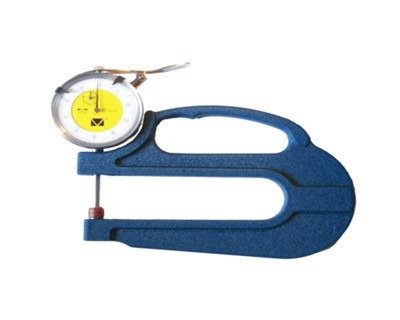
A dial thickness gauge holds the part between a fixed anvil and a spring-loaded spindle. The spindle movement turns a dial indicator, which shows the thickness directly. The frame’s throat depth limits how far from the edge you can measure. Anvil shape and measuring force are chosen to suit the material: flat anvils for hard sheet, ball anvils for curved parts and low force for soft materials.
Ultrasonic vs dial thickness gauge: side-by-side comparison
| Factor | Ultrasonic thickness gauge | Dial thickness gauge |
|---|---|---|
| Access needed | One side only | Both sides of the part |
| Measuring principle | Sound pulse travel time | Mechanical anvil and spindle |
| Typical materials | Steel, aluminium, many plastics, glass | Sheet metal, film, paper, rubber, leather, glass, wire |
| Best for | Pipes, tanks, vessels, hulls, castings, corrosion surveys | Sheet, strip, gaskets, film, small parts near an edge |
| Reach | Anywhere the probe can sit | Limited by throat depth |
| Setup | Set sound velocity; apply couplant | Zero the dial with anvils closed |
| Surface needs | Reasonably smooth contact area, couplant | Clean faces; no couplant |
| Soft materials | Possible for many, depends on material | Yes, with low measuring force |
| Speed | Fast spot readings | Very fast for repeated parts |
| Main error sources | Wrong velocity, poor coupling, rough or corroded surface | Wrong measuring force, dirt, burrs, anvil wear |
Always check the range and resolution on each product listing for your application.
What are the pros and cons of an ultrasonic thickness gauge?
Pros
- Measures from one side, so no need to cut or dismantle
- Ideal for corrosion and wall-loss surveys on installed equipment
- Works on large structures where no frame could reach
Cons
- Needs the correct sound velocity for each material
- Needs couplant and a usable contact surface
- Very thin, very rough or highly attenuating materials can be difficult
What are the pros and cons of a dial thickness gauge?
Pros
- Simple, direct reading with no setup beyond zero
- Works on soft, thin and non-metallic materials
- Low cost and no battery on analog models
Cons
- Needs access to both sides
- Reach limited by throat depth
- Measuring force can compress soft materials if not chosen correctly
Which thickness gauge should you choose?
Choose an ultrasonic thickness gauge when you can reach only one side, such as pipes, tanks, vessels and installed structures. Choose a dial thickness gauge when you can hold the part between two anvils, such as sheet, film, gaskets and small components. For coatings on metal, use a coating thickness gauge.
| Application | Best fit |
|---|---|
| Pipe wall loss in a refinery or plant | Ultrasonic |
| Storage tank and pressure vessel surveys | Ultrasonic |
| Ship hull and structural plate checks | Ultrasonic |
| Incoming sheet metal inspection | Dial (or a sheet metal micrometer near edges) |
| Rubber, gasket and leather thickness | Dial, low force |
| Plastic film and paper | Dial, flat anvils |
| Tube wall near the tube end | Dial with ball anvil, or a tube micrometer |
| Paint, powder coat or plating thickness | Coating thickness gauge |
Where does a coating thickness gauge fit?
Ultrasonic and dial gauges measure the base material. Paint, powder coating, galvanising and plating need a coating thickness gauge, which uses magnetic induction or eddy current methods. Read our guide to the coating thickness gauge for how those instruments work.
How do you keep thickness gauges accurate?
- Ultrasonic: check calibration on a reference block of the same material before each survey.
- Ultrasonic: replace worn probes and use fresh couplant.
- Dial: clean the anvils and check zero before use.
- Dial: use the correct measuring force for soft materials.
- Both: calibrate at defined intervals at an accredited lab.
BTSA supports calibration through NABL accredited calibration services at SV Precision Instruments.
Where can you buy thickness gauges in India?
BTSA has supplied precision measuring instruments since 1942. View the ultrasonic thickness gauge, the dial thickness gauge and Mitutoyo thickness gauges. For sheet and tube work, see the sheet metal micrometer and tube micrometer.
Request a quote for thickness gauges
Frequently asked questions
What is an ultrasonic thickness gauge used for?
It measures wall thickness from one side, mainly on pipes, tanks, vessels and structures.
What is a dial thickness gauge used for?
It measures the thickness of sheet, film, paper, rubber and small parts held between two anvils.
Why does an ultrasonic thickness gauge need couplant?
Couplant removes air between probe and surface so the sound pulse can enter the material.
Can an ultrasonic thickness gauge measure paint thickness?
A standard ultrasonic thickness gauge measures the base material. Use a coating thickness gauge for paint and plating.
Why does sound velocity matter in ultrasonic thickness measurement?
Sound travels at different speeds in different materials. A wrong velocity setting gives a wrong thickness.
Which gauge is better for soft materials like rubber?
A dial thickness gauge with low measuring force suits rubber, foam and gasket materials.