A micrometer is a precision measuring instrument that uses a calibrated screw mechanism to measure small linear distances. It delivers micron-level accuracy on dimensions like thickness, outside diameter, inside diameter, and depth. Manufacturing and quality assurance teams rely on micrometers when vernier calipers cannot deliver the required tolerance.
What is a micrometer?

A micrometer is a hand-held precision instrument used to measure small linear dimensions with high accuracy. It belongs to the screw-gauge family of metrology tools used widely in manufacturing inspection.
The instrument converts the rotation of a finely threaded spindle into a precise linear measurement. This mechanical principle allows readings far more accurate than what calipers can deliver for short dimensions.
In most manufacturing settings, a micrometer is the first tool reached for tight-tolerance verification. It plays a central role in dimensional inspection, machining quality control, and incoming material checks.
How does a micrometer work?
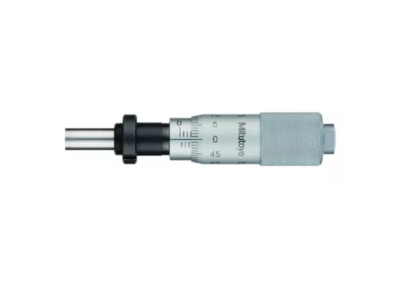
A micrometer works on the screw-and-thread principle, where one full turn of the thimble advances the spindle by a fixed distance. The user closes the spindle against a workpiece, then reads the dimension from the sleeve and thimble scales.
For a standard metric micrometer, one full rotation of the thimble typically advances the spindle by 0.5 mm. The thimble is divided into 50 equal parts, giving a least count of 0.01 mm on a standard analogue model.
Digital micrometers add an electronic encoder to deliver readings on an LCD, often resolving to 0.001 mm. The mechanical principle behind the screw remains identical to the analogue version.
What are the main types of micrometers?
The micrometer family includes several variants, each engineered for a specific measurement geometry. Selecting the correct type is critical for measurement accuracy and repeatability.
| Type | What it measures | Common application |
|---|---|---|
| Outside micrometer | External dimensions, diameters, thickness | Machined shafts, sheet metal, gauge blocks |
| Inside micrometer | Internal diameters and bores | Cylinder bores, housing diameters |
| Depth micrometer | Depth of holes, slots, and steps | Blind holes, recess depths, step heights |
| Tube micrometer | Wall thickness of tubes and pipes | Pipe manufacturing, heat-exchanger tubing |
| Thread micrometer | Pitch diameter of external threads | Fastener and thread quality control |
| Disc micrometer | Distance over gear teeth and flanges | Gear inspection, thin flange dimensions |
| Blade micrometer | Narrow grooves and slots | Slot widths, narrow features inaccessible to standard anvils |
Outside micrometers are by far the most common type in Indian manufacturing shops. Bore gauges or inside micrometers handle internal diameter checks where outside instruments cannot reach.
How accurate is a micrometer?
A standard mechanical micrometer typically resolves to 0.01 mm, while digital models commonly resolve to 0.001 mm. Resolution is not the same as accuracy, which depends on calibration, environmental conditions, and operator technique.
Accuracy is the difference between a measured value and the true value of the dimension. Resolution is simply the smallest increment the instrument can display.
A correctly calibrated micrometer from a recognised manufacturer typically holds its stated accuracy across its measuring range. Calibration drift, anvil wear, and ambient temperature all influence real-world accuracy.
Routine calibration through a NABL-accredited laboratory is the only way to maintain confidence in micrometer accuracy. BTSA operates NABL-accredited calibration facilities that service industrial micrometers across India.
Where are micrometers used?
Micrometers appear in any setting where small linear dimensions must be verified with confidence. They are critical to industries where dimensional tolerance directly influences product safety, function, or interchangeability.
- Automotive manufacturing. Engine components, fasteners, and machined assemblies need micron-level verification.
- Aerospace and defence. Tight tolerances on rotating parts and structural elements demand traceable micrometer measurements.
- Tool and die manufacturing. Die clearances, punch dimensions, and gauge blocks are routinely verified with micrometers.
- Quality control laboratories. Incoming inspection, in-process checks, and final-release measurements depend on calibrated micrometers.
- Education and training. Engineering colleges and ITIs use micrometers to teach metrology fundamentals.
How to choose the right micrometer
The right micrometer for any task depends on the measurement geometry, accuracy requirement, range, and frequency of use. A wrong selection introduces measurement uncertainty no calibration can correct.
1. Measurement geometry. External, internal, depth, thread, or specialised geometry decides which type of micrometer is suitable.
2. Measuring range. Standard outside micrometers come in 25 mm steps such as 0–25, 25–50, and 50–75 mm. Larger ranges need different frame sizes.
3. Resolution required. Choose 0.01 mm for general workshop measurement, and 0.001 mm digital for tight-tolerance inspection.
4. Reading method. Mechanical micrometers are robust and battery-free. Digital micrometers reduce reading errors and support data output to QC software.
For most QA labs and machining floors, a Mitutoyo digital outside micrometer is the workhorse choice. Specialised geometries are then added as production needs evolve.
Frequently asked questions
What is the least count of a standard micrometer?
The least count of a standard mechanical micrometer is 0.01 mm. Digital micrometers commonly resolve to 0.001 mm. Least count is the smallest displayable increment, not the same as the instrument’s accuracy.
What is the difference between a micrometer and a vernier caliper?
A micrometer uses a precision screw mechanism and typically resolves to 0.01 mm or 0.001 mm. A vernier caliper uses a sliding scale and typically resolves to 0.02 mm or 0.05 mm. Micrometers are more accurate but cover a smaller range per instrument.
Can a micrometer measure inside diameters?
A standard outside micrometer cannot measure inside diameters. Internal measurements require inside micrometers, three-point internal micrometers, or bore gauges. The choice depends on the bore diameter and the required accuracy.
How often should a micrometer be calibrated?
Most quality systems recommend annual calibration for general-use micrometers. High-precision or heavy-use micrometers may need six-monthly intervals. Calibration frequency depends on usage, environment, and the quality standard in force.
Is a digital micrometer more accurate than a mechanical one?
A digital micrometer offers higher resolution and reduces reading errors. Accuracy depends on the manufacturer specification and the instrument’s calibration status. A well-calibrated mechanical micrometer can be as accurate as a digital model in its class.
What is the role of NABL accreditation in micrometer calibration?
NABL-accredited calibration provides traceable measurements aligned with national standards. A NABL calibration certificate is required in most regulated industries and quality systems. It assures the user that the micrometer’s stated accuracy is verified against recognised references.
Why source your micrometers from BTSA
BTSA, established in 1942, is one of India’s most experienced suppliers of precision measuring instruments. We are an authorised distributor for Mitutoyo and a curated set of metrology brands serving Indian manufacturing.
Our NABL-accredited calibration laboratories support customers across Mumbai, Chennai, Bangalore, Hyderabad, and Coimbatore. Whether you need a single outside micrometer or a complete QA-lab fit-out, our specialists can guide selection and after-sales support.